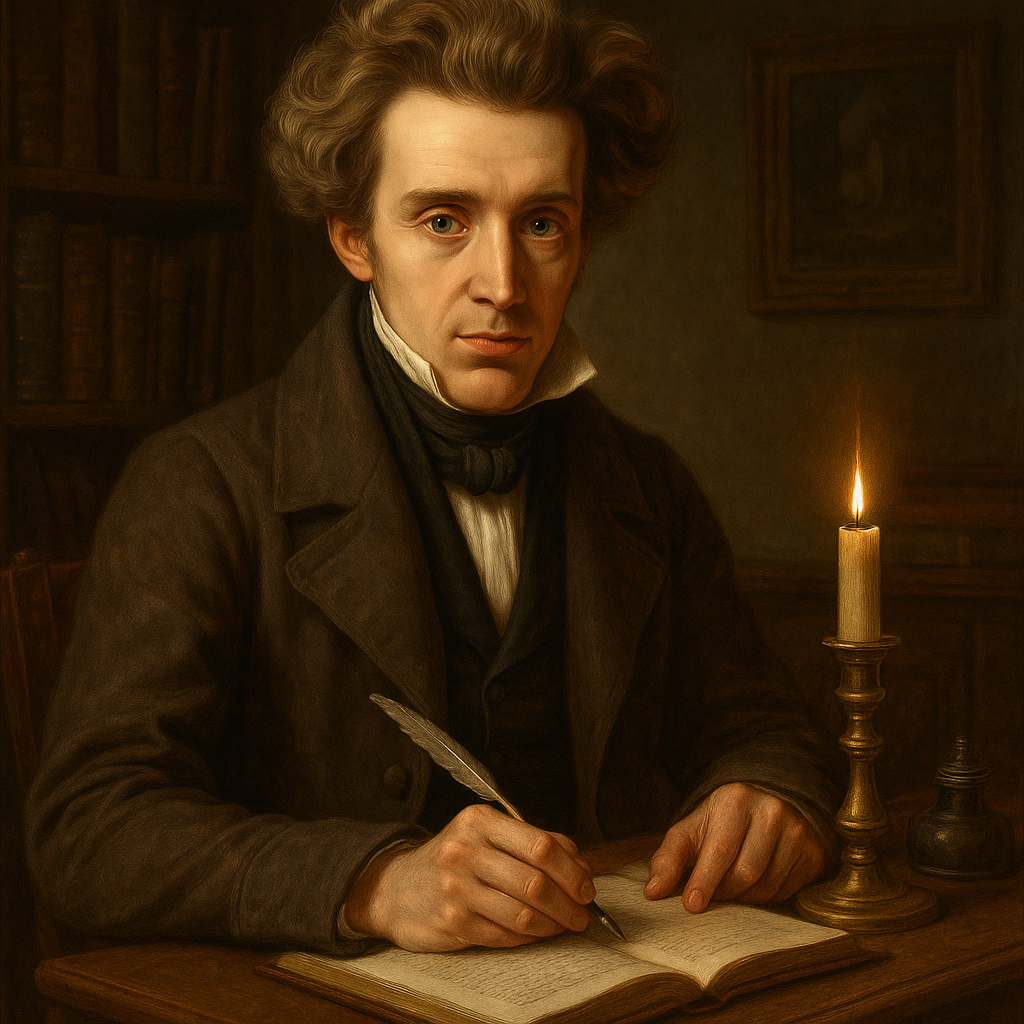
Søren Kierkegaard: The "Father of Existentialism"
Søren Kierkegaard was a Danish thinker who gained significant posthumous recognition for his profound ideas about the human condition. He is widely regarded as the "father of existentialism," a philosophical movement emphasizing individual freedom and responsibility (Stanford Encyclopedia of Philosophy 2023; Britannica 2024).
Early Life and Influences
Born in Copenhagen, Denmark, on May 5, 1813, Søren was the youngest of seven children (Hannay 2003; Dru 1938). His father, Michael Pedersen Kierkegaard, a wealthy, serious, and deeply religious man who had been a shepherd in his youth, profoundly influenced him (Hannay 2003; Garff 2000). Michael believed he had committed a great sin by cursing God, a belief that cast a long shadow over Søren’s childhood (Garff 2000; Hannay 2003).
Søren’s mother, Ane Sørensdatter Lund, was a quieter influence. The intense home life, especially his father’s religious struggles, deeply shaped Søren’s later thoughts on faith, guilt, and the human condition (Stanford Encyclopedia of Philosophy 2023; Dru 1938).
Academic Journey and Early Works
Søren was intellectually gifted and attended the University of Copenhagen, where he studied theology, Latin, and philosophy (Garff 2000; Hannay 2003). In 1841, he earned his master's degree with a dissertation titled On the Concept of Irony with Continual Reference to Socrates (Hannay 2003; Dru 1938). This early work showcased his clever, often indirect, writing style.
Philosophical Approach
Kierkegaard distinguished himself by his personal exploration of grand questions. Unlike contemporaries who relied solely on logic, he delved into emotions such as anxiety, despair, and faith, making his writings profoundly relatable (Marin 2010; Stanford Encyclopedia of Philosophy 2023). He often used various pen names, or pseudonyms, for his books, each embodying a distinct personality and viewpoint (Marin 2010; Hannay 2003). This created a dynamic intellectual discourse, as if a cast of characters were debating crucial ideas.
Hallmark Moments in Kierkegaard's Career
- 1843: Published Either/Or, a foundational work exploring contrasting modes of existence: the aesthetic (focused on beauty and pleasure) versus the ethical (focused on duty and responsibility) (Dru 1938; Garff 2000).
- 1844: Released Fear and Trembling, a profound reflection on the biblical story of Abraham and Isaac, examining the demands of faith (Marin 2010; Hannay 2003).
- 1846: Engaged in a significant public debate with The Corsair, a satirical newspaper that relentlessly mocked him (Garff 2000; Hannay 2003), making him a controversial public figure.
Quirky Corner: Glimpses into Kierkegaard's Life
- Søren enjoyed walking around Copenhagen, engaging in conversations with people from all social strata, from professors to common folk (Garff 2000). He frequently stopped to speak with strangers, attentively listening to their stories.
- He broke off his engagement to Regine Olsen, whom he deeply loved (Hannay 2003). He believed his melancholic nature and his "calling" as a writer and thinker rendered him unable to make her happy (Garff 2000; Marin 2010). This personal sacrifice became a central theme in his writings.
- Despite his serious reputation, he possessed a keen wit and ironic sense of humor, often evident in his personal journals and letters (Hannay 2003).
Søren Kierkegaard passed away on November 11, 1855, at just 42 years old (Dru 1938; Garff 2000). His ideas were largely unrecognized in his lifetime and country, but his influence grew enormously after his death (Marin 2010; Stanford Encyclopedia of Philosophy 2023). He inspired numerous subsequent philosophers, writers, and theologians. His emphasis on individual choice, anxiety, and the search for meaning remains profoundly relevant today (Britannica 2024; Stanford Encyclopedia of Philosophy 2023). He demonstrated that philosophical inquiry can be a deeply personal and dramatic adventure.
Fast Facts
- Born: May 5, 1813, Copenhagen, Denmark
- Died: November 11, 1855, Copenhagen, Denmark
- Notable Works: Either/Or (1843), Fear and Trembling (1844), The Concept of Anxiety (1844), Concluding Unscientific Postscript to Philosophical Fragments (1846)
- Signature Quote: "To dare is to lose one's footing momentarily. Not to dare is to lose oneself." (Marin 2010)
Sources
- Britannica. (2024). Søren Kierkegaard. Encyclopaedia Britannica. Retrieved from https://www.britannica.com/biography/Soren-Kierkegaard
- Dru, A. (1938). The Journals of Søren Kierkegaard. Oxford University Press.
- Garff, J. (2000). Søren Kierkegaard: A Biography. Princeton University Press.
- Hannay, A. (2003). Kierkegaard: A Biography. Cambridge University Press.
- Marin, M. (2010). Kierkegaard: A Guide for the Perplexed. Continuum.
- Stanford Encyclopedia of Philosophy. (2023). Søren Kierkegaard. Stanford Encyclopedia of Philosophy. Retrieved from https://plato.stanford.edu/entries/kierkegaard/