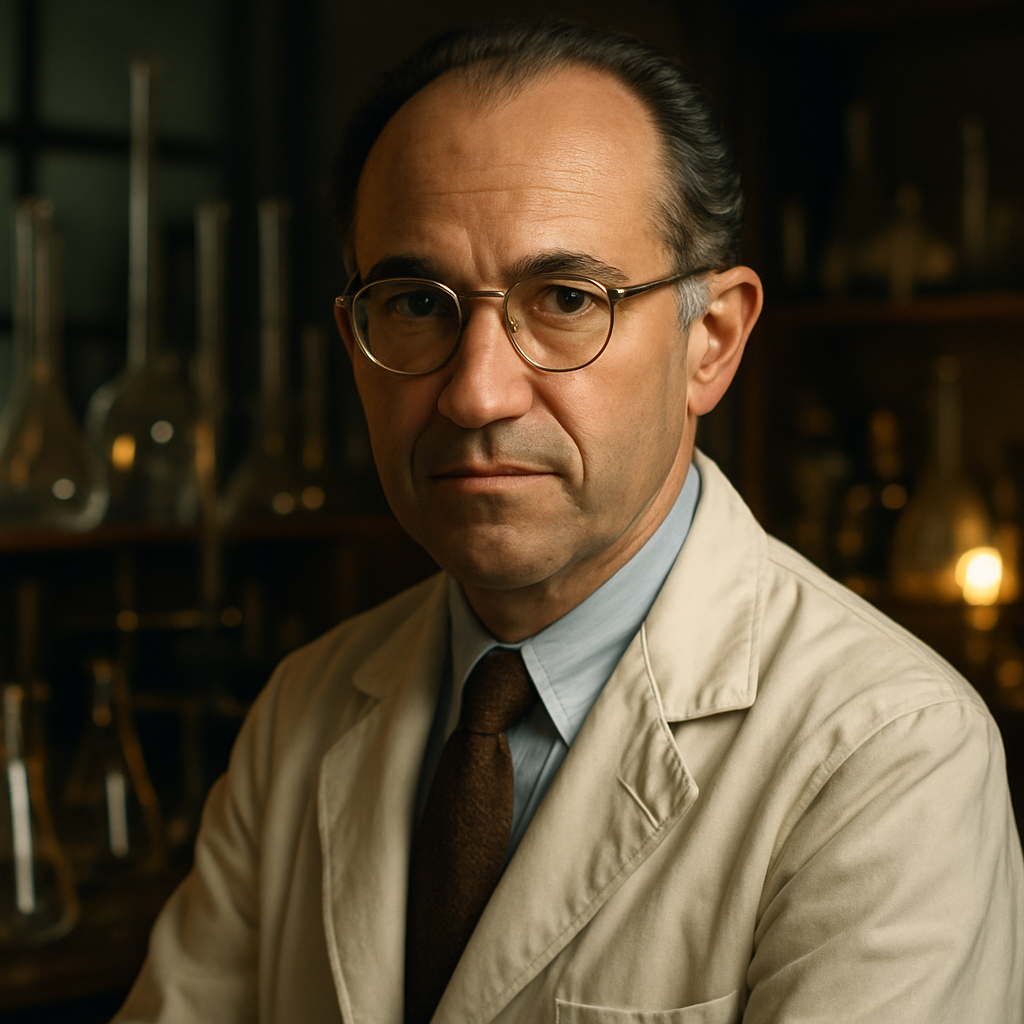
Jonas Salk: The Scientist Who Conquered Polio
Imagine a world where a terrible disease, polio, paralyzed and even killed children, leaving families heartbroken. Then, a hero stepped forward: Jonas Salk. He wasn't a superhero in a cape, but a scientist in a lab coat, and he gave the world one of its greatest gifts: a vaccine that conquered polio and saved countless lives (The Salk Institute, n.d.; CDC, 2021).
Early Life and Inspiration
Jonas Salk was born in New York City in 1914 to immigrant parents, Daniel and Dora Salk (Salk, 1999; PBS, 1999). Even as a young boy, he was curious and loved learning. He didn't initially plan to become a doctor, but his passion for science led him to New York University School of Medicine (Salk, 1999; The Salk Institute, n.d.). As a medical student, he was fascinated by research and the idea of preventing diseases rather than just treating them (PBS, 1999).
The Polio Challenge
After medical school, Salk began working on influenza (flu) research at the University of Pittsburgh (PBS, 1999). It was there, with support from the National Foundation for Infantile Paralysis (which later became the March of Dimes), that he started his groundbreaking work on polio (March of Dimes, n.d.; The Salk Institute, n.d.).
Polio was a terrifying illness. In the early 1950s, outbreaks were common, and parents lived in fear (CDC, 2021). Salk believed he could create a vaccine using a "killed virus" approach – a method that was less popular at the time but proved to be incredibly effective (Salk, 1999; PBS, 1999).
Developing the Vaccine
His journey was a massive undertaking, involving years of dedicated work and the help of a big team. They grew the polio virus in laboratories, then inactivated it so it couldn't cause disease but could still teach the body how to fight it (The Salk Institute, n.d.; Salk, 1999).
The final test was huge: millions of children participated in one of the largest clinical trials in history (March of Dimes, n.d.; CDC, 2021). On April 12, 1955, the world received the incredible news: the Salk polio vaccine was safe and effective (PBS, 1999; The Salk Institute, n.d.). It was a day of immense celebration.
Hallmark Moments
Here are some hallmark moments from his life:
- 1955: Announcement of the successful polio vaccine (PBS, 1999).
- 1960: Founded the Salk Institute for Biological Studies in La Jolla, California, a world-renowned center for scientific research (The Salk Institute, n.d.).
- Recipient of the Presidential Medal of Freedom: The highest civilian honor in the United States, awarded in 1985 (Reagan Library, 1985).
A Man for Humanity
Jonas Salk was a quiet man who preferred his lab to the limelight. When asked who owned the patent for his vaccine, he famously replied, "The people, I would say. There is no patent. Could you patent the sun?" (PBS, 1999; The Salk Institute, n.d.). This showed his deep commitment to humanity over personal gain. He never patented the vaccine, which meant anyone could produce it, making it more widely available and affordable (Salk, 1999; PBS, 1999).
Lasting Legacy
Salk's work didn't just stop polio; it changed how we think about vaccines and public health forever. His legacy lives on through the Salk Institute, where scientists continue to work on some of the world's most challenging diseases, inspired by his vision (The Salk Institute, n.d.). He taught us that with dedication and a focus on serving others, science can truly change the world for the better.
Fast Facts
- Born: October 28, 1914, New York City (PBS, 1999)
- Died: June 23, 1995, La Jolla, California (The Salk Institute, n.d.)
- Notable Work: Developed the first successful polio vaccine (The Salk Institute, n.d.)
- Signature Quote: "Hope lies in dreams, in imagination, and in the courage of those who dare to make dreams into reality." (Salk, 1999)
Sources
- Centers for Disease Control and Prevention (CDC). (2021, May 14). History of Polio. Retrieved from https://www.cdc.gov/polio/what-is-polio/polio-us/history.html
- March of Dimes. (n.d.). Our History. Retrieved from https://www.marchofdimes.org/about-us/our-history
- PBS. (1999). Jonas Salk. American Experience. Retrieved from https://www.pbs.org/wgbh/amex/polio/salk.html
- Ronald Reagan Presidential Library & Museum. (1985, November 13). Remarks on Presenting the Presidential Medal of Freedom to Dr. Jonas Salk. Retrieved from https://www.reaganlibrary.gov/archives/speech/remarks-presenting-presidential-medal-freedom-dr-jonas-salk
- Salk, J. (1999). Jonas Salk: A Life as a Scientist, Physician, and Philosopher. (D. Slaff, Ed.). University of California Press.
- The Salk Institute for Biological Studies. (n.d.). About Jonas Salk. Retrieved from https://www.salk.edu/about/jonas-salk/