The Philosopher Who Said No: Jean-Paul Sartre
Ever heard of a thinker so revolutionary he turned down a Nobel Prize?
Meet Jean-Paul Sartre, a brilliant French philosopher, writer, and political activist who championed freedom and responsibility like no other. He famously believed we are "condemned to be free" – meaning we get to choose our own path, a concept both empowering and daunting. (Macmillan 2011; Stanford 2004).
Born in Paris, France, in 1905, Jean-Paul had a unique childhood. His father, Jean-Baptiste Sartre, a naval officer, sadly passed away when Jean-Paul was an infant (Collins 2000). He was then raised by his mother, Anne-Marie, and his exceptionally intelligent grandfather, Charles Schweitzer, a German professor who even taught him mathematics (Hayman 1987; Gerassi 1989). This early exposure to learning clearly ignited his intellectual curiosity. He was a whiz kid who loved to read, spending hours exploring books, especially classics (Cohen-Solal 1987).
As he matured, Sartre became one of the most important thinkers of the 20th century. He was a key figure in existentialism, a philosophy positing that humans lack a pre-set purpose; instead, we create our own meaning through our choices and actions (Stanford 2004). He authored seminal works such as "Being and Nothingness," a profound exploration of human freedom, and "Nausea," a novel delving into feelings of alienation (Macmillan 2011).
Hallmark Moments
- 1943: Published "Being and Nothingness," his most famous philosophical work, solidifying his status as a leading existentialist (Collins 2000).
- 1945: Co-founded the influential literary and political journal, Les Temps modernes (Modern Times), which became a crucial platform for his ideas (Hayman 1987).
- 1964: Awarded the Nobel Prize in Literature, but famously declined it, stating his consistent refusal of official honors (Nobel Foundation 1964; New York Times 1964).
Quirky Corner
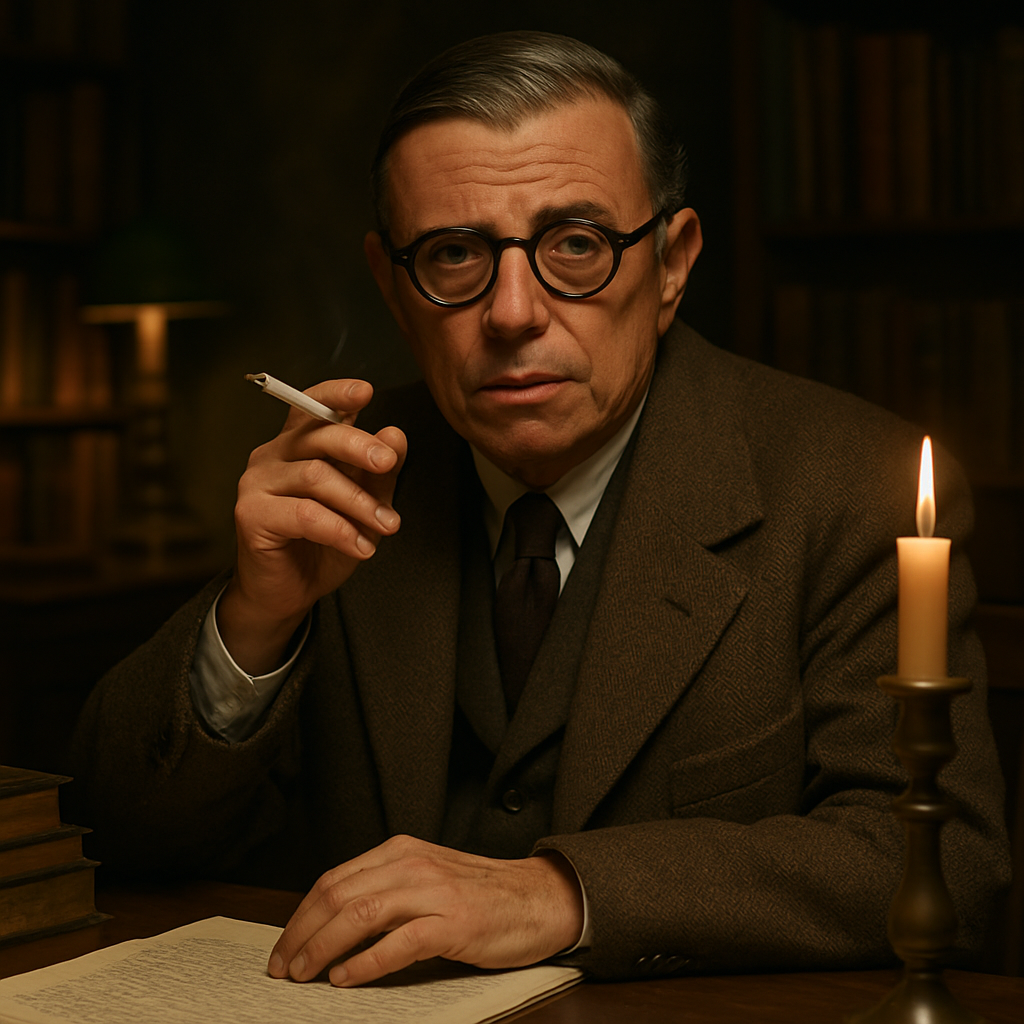
- Sartre was recognizable for his distinct look, often sporting thick-rimmed glasses and a pipe, which became almost as iconic as he was (Gerassi 1989).
- He maintained a lifelong open relationship with the equally brilliant writer and philosopher Simone de Beauvoir (Collins 2000). They never married but were intellectual partners, supporting each other's work for over 50 years (Hayman 1987).
- He was known to enjoy drinking, smoking, and strong coffee (Cohen-Solal 1987).
Sartre's ideas transformed contemporary thought on freedom, responsibility, and the meaning of life. He was not merely a writer; he was deeply involved in politics, supporting anti-colonial movements and speaking out against injustice (New York Times 1980). His work continues to inspire artists, writers, and thinkers today, reminding us that our choices truly matter.
Fast Facts Box
- Born: June 21, 1905, Paris, France
- Died: April 15, 1980, Paris, France
- Notable Works: Being and Nothingness (1943), Nausea (1938), No Exit (1944)
- Signature Quote: "Man is condemned to be free; because once thrown into the world, he is responsible for everything he does." (Cited in Collins 2000)
Sources
- Cohen-Solal, Annie. Sartre: A Life. Pantheon Books, 1987.
- Collins, Jeffrey. Sartre. Oneworld Publications, 2000.
- Gerassi, John. Jean-Paul Sartre: Hated Conscience of His Century. University of Chicago Press, 1989.
- Hayman, Ronald. Sartre: A Biography. Simon & Schuster, 1987.
- Macmillan, Peter. "Jean-Paul Sartre." The Stanford Encyclopedia of Philosophy, Spring 2011 Edition.
- New York Times. "Jean-Paul Sartre Declines Nobel Prize." The New York Times, October 24, 1964.
- New York Times. "Jean-Paul Sartre Dies in Paris at 74." The New York Times, April 16, 1980.
- Nobel Foundation. "The Nobel Prize in Literature 1964." NobelPrize.org, 1964.
- Stanford Encyclopedia of Philosophy. "Jean-Paul Sartre." The Stanford Encyclopedia of Philosophy, Fall 2004 Edition.