John von Neumann: The Mind That Shaped the Modern World
Imagine a mind so brilliant, it tackled problems that made other super-smart people scratch their heads! That was John von Neumann, a true genius whose ideas helped shape our modern world, from computers to weather forecasts (Macrae 1999; Aspray 1990).
Early Life and Prodigy
Born János Lajos Neumann in Budapest, Hungary, on December 28, 1903, young Johnny was a child prodigy (Macrae 1999). His father, Max, was a wealthy lawyer, and his mother, Margit, ensured a cultured home, with tutors for Johnny and his two younger brothers (Aspray 1990).
Even as a little boy, John showed an incredible memory and a love for numbers. By age six, he could divide eight-digit numbers in his head, and he'd memorized phone book pages for fun (Macrae 1999). He even chatted with his father's colleagues in ancient Greek! (Aspray 1990). This amazing start hinted at the groundbreaking work he'd do later.
Academic Journey and Early Contributions
John's journey led him through fascinating fields. Though he earned a diploma in chemical engineering (to please his family), his true passion was mathematics, which he studied at the University of Berlin and the University of Zurich (Macrae 1999).
He quickly made a name for himself, contributing to quantum mechanics (the science of tiny particles) and developing the theory of games, which helps understand how people make decisions when they depend on what others do (Aspray 1990). The 1930s brought him to the United States, where he became one of the first professors at the prestigious Institute for Advanced Study in Princeton, New Jersey (Macrae 1999).
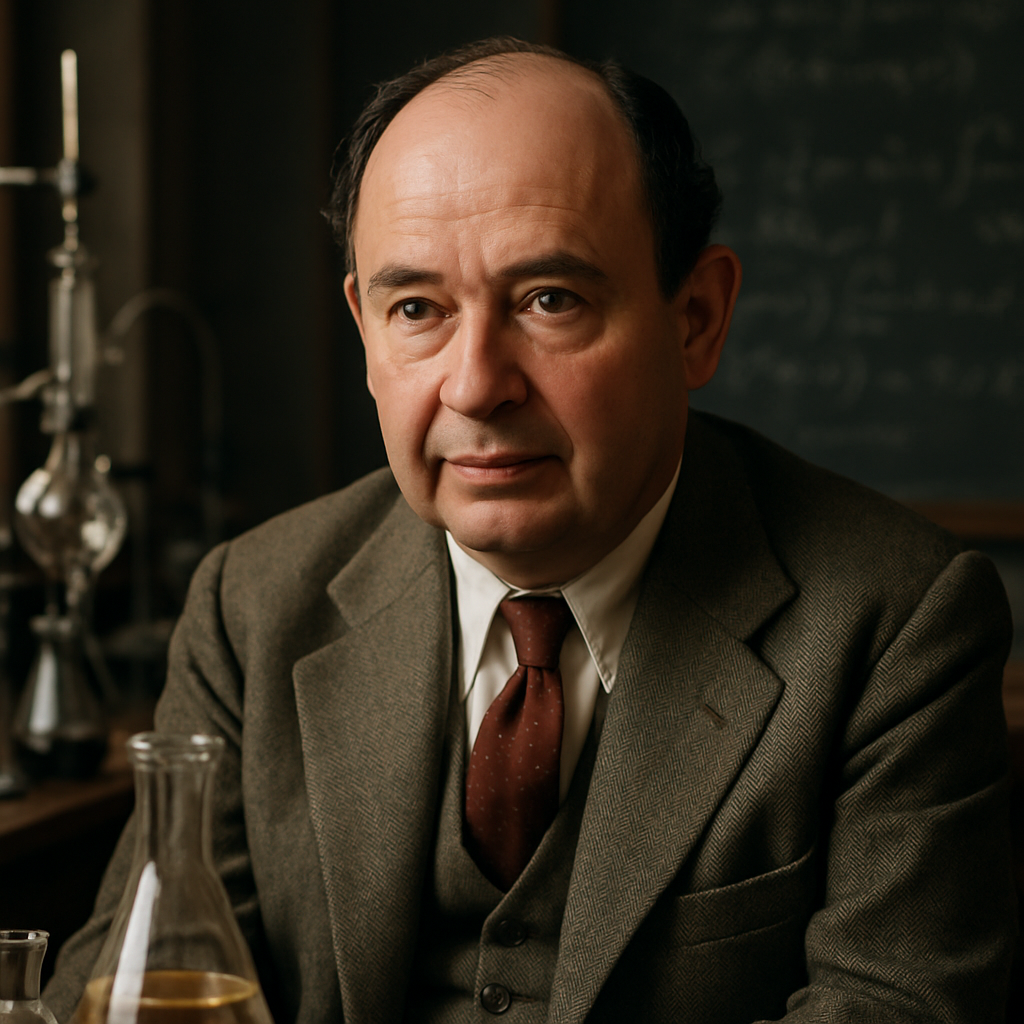
Hallmarks of a Genius: Key Contributions
It was at Princeton that von Neumann truly began to revolutionize computing and other fields. Here are some of his hallmark moments:
-
The "von Neumann Architecture": This isn't a building style, but a blueprint for almost all modern computers (Aspray 1990). It describes how a computer should store both its instructions (the program) and the data it's working on in the same memory (Herman Goldstine 1980). This simple, elegant idea changed everything.
-
Manhattan Project: During World War II, von Neumann was a vital part of the top-secret project to build the atomic bomb (Rhodes 1986). He used his mathematical skills to solve complex problems related to the bomb's design, particularly the explosive lenses needed for detonation (Macrae 1999).
-
Game Theory: His book, Theory of Games and Economic Behavior, co-authored with Oskar Morgenstern, founded the field of game theory (Neumann & Morgenstern 1944). This field is now used in economics, politics, biology, and even military strategy (Aspray 1990).
-
Cellular Automata: He also pioneered the idea of "cellular automata," which are simple grids of cells that follow basic rules but can create incredibly complex patterns—think of Conway's Game of Life (Aspray 1990). This paved the way for understanding self-reproducing machines and complex systems.
Quirk and Personality
Beyond his incredible intellect, von Neumann had a few quirky traits. He was known for his love of lively parties and a good joke (Macrae 1999). Despite being a mathematical genius, he was famously a terrible driver, often getting into minor accidents (Aspray 1990). He also loved to eat well and was known for enjoying elaborate meals (Macrae 1999).
Fast Facts Box
- Born: December 28, 1903, Budapest, Hungary (Macrae 1999)
- Died: February 8, 1957, Washington D.C., USA (Macrae 1999)
- Notable Works: Theory of Games and Economic Behavior (1944), influential reports on computer design (Herman Goldstine 1980).
- Signature Quote: "If people do not believe that mathematics is simple, it is only because they do not realize how complicated life is." (Aspray 1990)
Enduring Legacy
John von Neumann's ripple effect on our world is immense. His computer architecture is still the basis of the smartphones, laptops, and supercomputers we use every day (Aspray 1990). His work on nuclear weapons had a profound impact on history. And his ideas on game theory continue to help us understand decision-making in everything from business deals to international relations (Macrae 1999).
He was a true visionary, always thinking about the future and how mathematics could solve its biggest challenges.
Sources:
- Aspray, William. (1990). John von Neumann and the Origins of Modern Computing. MIT Press.
- Goldstine, Herman H. (1980). The Computer from Pascal to von Neumann. Princeton University Press.
- Macrae, Norman. (1999). John von Neumann: The Scientific Genius Who Pioneered the Modern Computer, Game Theory, Nuclear Deterrence, and Complex Self-Reproducing Machines. Pantheon Books.
- von Neumann, John, & Morgenstern, Oskar. (1944). Theory of Games and Economic Behavior. Princeton University Press.
- Rhodes, Richard. (1986). The Making of the Atomic Bomb. Simon & Schuster.