James Clerk Maxwell: The Maestro of Light and Invisible Waves
Imagine a world where the dazzling ballet of light was a mystery, and the invisible forces of electricity and magnetism were like separate, puzzling pieces of a cosmic jigsaw.
Then, along came a brilliant mind from Scotland, James Clerk Maxwell, who didn't just solve the puzzle—he showed us how it all danced together. This incredible scientist, born in Glenlair, Scotland, in 1831, was the first to truly describe how light, electricity, and magnetism are all part of the same amazing show (Encyclopedia Britannica 2023; Nature 2006).
Early Life and Curiosity
Young James was a curious kid, always asking questions. Once, he famously asked about "the go o' that"—wanting to understand how things worked (Scottish Field 2011). His early home life at Glenlair was filled with exploration, and though his mother died when he was young, his father encouraged his inquisitive nature (University of Glasgow 2023).
He went on to study at the University of Edinburgh and then Cambridge, where his genius really began to shine (Nature 2006).
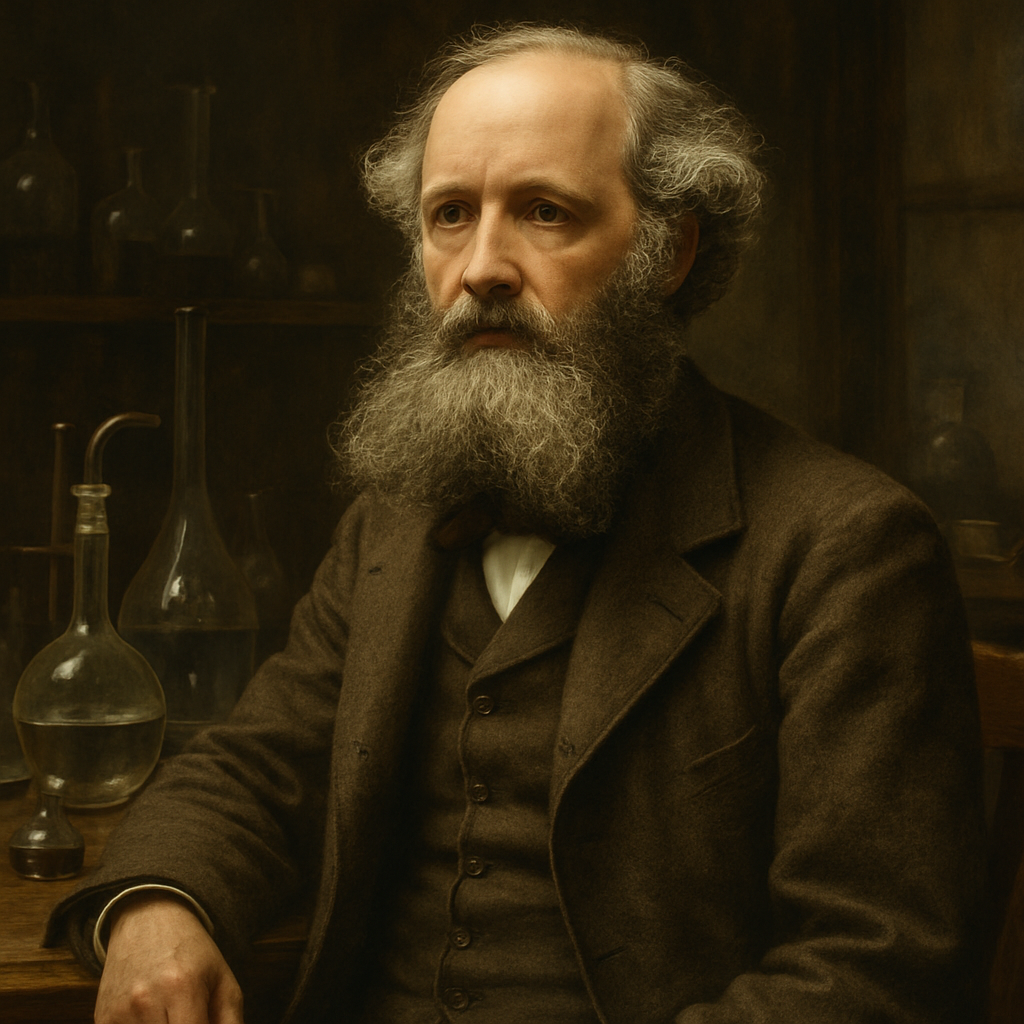
The Unification of Forces
Maxwell’s journey to discovery wasn't a sudden flash; it was a meticulous and groundbreaking exploration. He built upon the work of giants like Michael Faraday, who had intuitive ideas about electromagnetic fields.
Maxwell, with his incredible mathematical prowess, translated these ideas into a set of elegant equations – Maxwell's Equations (American Institute of Physics 2020; IEEE Global History Network 2023). These four equations became the bedrock of modern physics, revealing that changes in electric fields produce magnetic fields, and vice versa. This incredible insight led to his most stunning prediction: that light itself is an electromagnetic wave, traveling at a constant speed (NASA 2019; American Institute of Physics 2020).
Hallmark Moments
- Maxwell's Equations (1861-1865): These four equations unified electricity, magnetism, and light, revolutionizing physics (American Institute of Physics 2020).
- Prediction of Radio Waves (1864): His equations predicted the existence of electromagnetic waves beyond visible light, paving the way for radio, television, and Wi-Fi (IEEE Global History Network 2023).
- First Color Photograph (1861): Maxwell produced the world's first durable color photograph, demonstrating his theories on color perception (Smithsonian Magazine 2010; Science Museum Group 2023).
- Theory of Saturn's Rings (1859): He mathematically proved that Saturn's rings could not be solid, but rather were made of countless small particles, a feat later confirmed by space probes (NASA 2019; University of Cambridge 2023).
Quirky Corner
- Maxwell was a keen poet and often expressed scientific ideas through verse (University of Glasgow 2023).
- He loved practical jokes and was known for his witty humor among friends (Scottish Field 2011).
- He had a deep affection for animals, especially his terrier, Toby (University of Cambridge 2023).
Maxwell's ripple effect on our world is immeasurable. Every time you turn on a light, use a cell phone, listen to the radio, or stream a video, you're experiencing the direct legacy of his work. He died young, at just 48, in 1879, leaving behind a legacy that continues to inspire and enable technologies we now take for granted (Nature 2006).
Albert Einstein himself said, "One scientific epoch ended and another began with James Clerk Maxwell" (Encyclopaedia Britannica 2023). His brilliant mind didn't just understand the universe; it showed us how to tune into its invisible symphony.
Fast Facts Box
- Born: June 13, 1831, Edinburgh, Scotland (Encyclopaedia Britannica 2023)
- Died: November 5, 1879, Cambridge, England (Encyclopaedia Britannica 2023)
- Known For: Maxwell's Equations, Electromagnetism, Theory of Saturn's Rings, Color Photography (American Institute of Physics 2020; NASA 2019)
- Notable Works: A Treatise on Electricity and Magnetism (1873) (American Institute of Physics 2020)
- Signature Quote: "The only way of avoiding error is to get rid of the idea that we know beforehand what the order of the universe must be." (University of Glasgow 2023)
Sources
- American Institute of Physics. (2020). James Clerk Maxwell. https://history.aip.org/history/acap/biographies/maxwell_james.jsp
- Encyclopaedia Britannica. (2023). James Clerk Maxwell. https://www.britannica.com/biography/James-Clerk-Maxwell
- IEEE Global History Network. (2023). James Clerk Maxwell. https://ethw.org/James_Clerk_Maxwell
- NASA. (2019). James Clerk Maxwell. https://solarsystem.nasa.gov/resources/437/james-clerk-maxwell/
- Nature. (2006). Physics: A life in light. https://www.nature.com/articles/442750a
- Science Museum Group. (2023). First Colour Photograph. https://www.sciencemuseumgroup.org.uk/our-collection/objects/1937-295/
- Scottish Field. (2011). Celebrating James Clerk Maxwell. https://www.scottishfield.co.uk/culture/celebrating-james-clerk-maxwell/
- Smithsonian Magazine. (2010). The First Color Photograph. https://www.smithsonianmag.com/arts-culture/the-first-color-photograph-102738734/
- University of Cambridge, Maxwell Centre. (2023). Maxwell's Biography. https://www.maxwell.cam.ac.uk/about-maxwell/maxwells-biography
- University of Glasgow. (2023). James Clerk Maxwell Biography. https://www.gla.ac.uk/schools/physics/research/condensedmatter/superconductivity/mac-maxwell/maxwellbiography/