Wangari Maathai: The Tree-Planting Peace Prize Winner
Get ready to meet a true superhero, but not one who wears a cape! Wangari Maathai was a powerhouse from Kenya, a woman who proved that one person, armed with passion and a whole lot of trees, could change the world. She fought tirelessly to protect our planet and stand up for human rights, earning her the incredible honor of being the first African woman to win the Nobel Peace Prize! (Nobel Prize Outreach AS 2023)
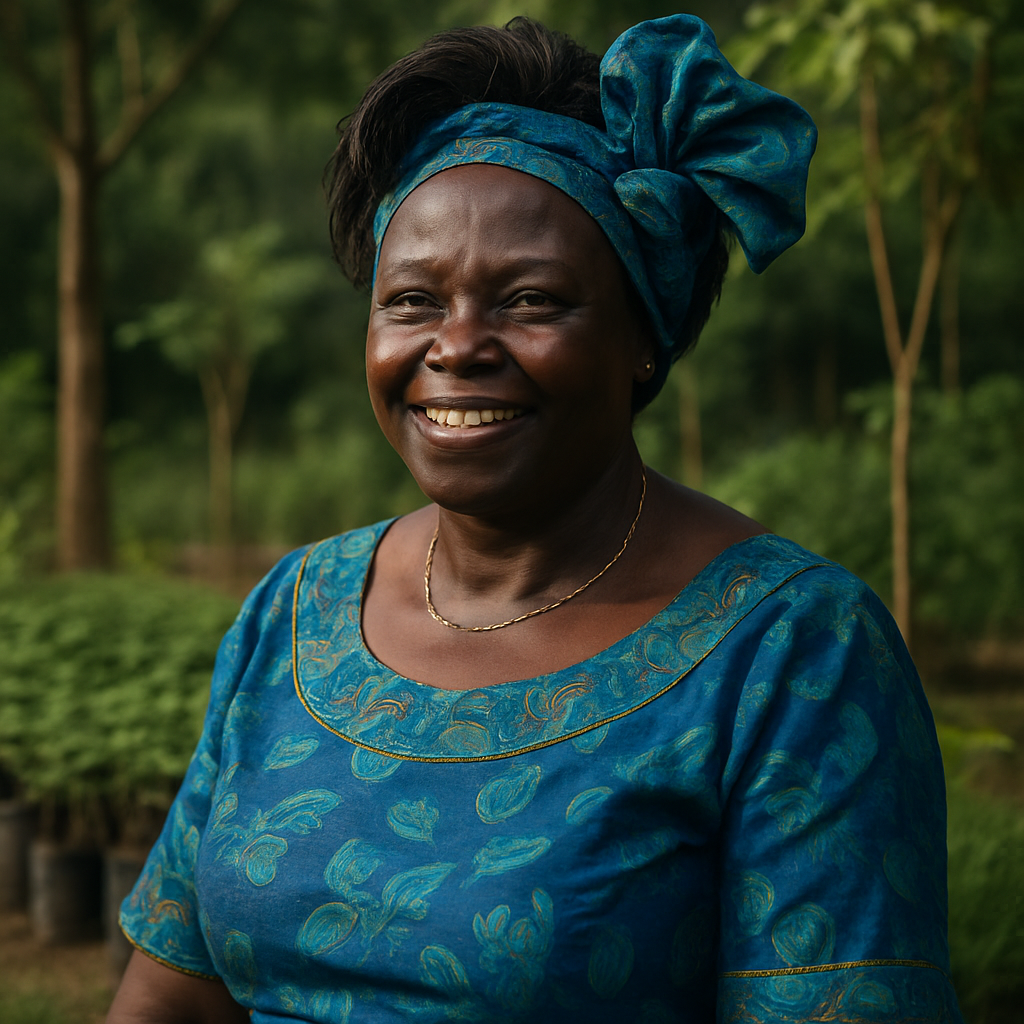
Early Life and Education
Wangari Muta Maathai was born in 1940 in a village called Ihithe, nestled in the central highlands of Kenya. Her family belonged to the Kikuyu ethnic group, and young Wangari grew up surrounded by the lush beauty of nature, learning from her mother the importance of respecting the land. (The Green Belt Movement Undated)
She was a bright spark, and unlike many girls in rural Kenya at the time, she was sent to school. (The Nobel Foundation 2004) She even earned a scholarship to study in the United States, attending Mount St. Scholastica College in Kansas and later the University of Pittsburgh to study biological sciences. (The Green Belt Movement Undated) Talk about an amazing journey!
Returning Home and Finding Her Mission
When Wangari returned to Kenya, she faced challenges, but she didn’t give up. She became the first woman in East and Central Africa to earn a Ph.D. (University of Nairobi 2023) and later taught veterinary anatomy at the University of Nairobi, eventually becoming the first woman to be a professor there! (Nobel Prize Outreach AS 2023)
But her biggest dream was to heal her homeland, which was suffering from deforestation and poverty. She noticed that women in her community were struggling to find firewood and clean water due to environmental damage. (The Green Belt Movement Undated)
Founding The Green Belt Movement
This lit a fire in Wangari. In 1977, she started a movement that would grow to be world-famous: The Green Belt Movement. (The Green Belt Movement Undated) It was a simple but brilliant idea: encourage women to plant trees to restore the environment, provide food, and create income.
It wasn't just about trees, though; it was about empowering women, promoting democracy, and urging people to take care of their land. She often faced harsh criticism and even violence from the government for her activism, but she never backed down. (The Nobel Foundation 2004) She once famously said, "When we plant trees, we plant the seeds of peace and hope." (The Green Belt Movement Undated)
Hallmark Moments:
- 1977: Founded The Green Belt Movement, which has planted millions of trees across Africa. (The Green Belt Movement Undated)
- 2002-2007: Served as a Member of Parliament in Kenya, pushing for environmental and human rights legislation. (Parliament of Kenya Undated)
- 2004: Awarded the Nobel Peace Prize for her contributions to sustainable development, democracy, and peace. (Nobel Prize Outreach AS 2023)
- 2009: Named a United Nations Messenger of Peace. (United Nations Undated)
Quirky Corner:
- Wangari’s love for nature started very early! As a child, she would often play by a stream and help her mother farm, learning about plants directly from the soil. (The Nobel Foundation 2004)
- She used to joke that people often mistook her for a "tree hugger" but that she was really just helping people understand that a healthy environment is crucial for healthy lives. (The Green Belt Movement Undated)
- Even after becoming a Nobel laureate, she remained down-to-earth and continued to inspire people with her direct, practical approach to solving big problems. (The Nobel Foundation 2004)
Wangari Maathai passed away in 2011, but her legacy continues to grow like the trees she planted. The Green Belt Movement thrived and spread, inspiring similar efforts around the globe. She showed us that environmental protection is deeply connected to human rights, democracy, and peace. Her life reminds us all that even the biggest challenges can be overcome with courage, community, and a commitment to protecting our beautiful planet. She truly made the world a greener, fairer place for everyone.
Fast Facts:
- Born: April 1, 1940
- Died: September 25, 2011
- Notable Works: The Green Belt Movement, Unbowed: A Memoir, The Challenge for Africa
- Signature Quote: "It's the little things citizens do. That's what will make the difference." (The Green Belt Movement Undated)
Sources:
- Nobel Prize Outreach AS. (2023). The Nobel Peace Prize 2004. Retrieved from https://www.nobelprize.org/prizes/peace/2004/maathai/facts/
- Parliament of Kenya. (Undated). Hon. Prof. Wangari Maathai. Retrieved from https://www.parliament.go.ke/node/30438 (Information about her parliamentary service)
- The Green Belt Movement. (Undated). About Wangari Maathai. Retrieved from https://www.greenbeltmovement.org/wanagari-maathai
- The Nobel Foundation. (2004). Wangari Maathai - Biographical. Retrieved from https://www.nobelprize.org/prizes/peace/2004/maathai/biographical/
- United Nations. (Undated). Wangari Maathai: Messenger of Peace. Retrieved from https://www.un.org/sustainabledevelopment/blog/2012/06/wangari-maathai-messenger-of-peace/
- University of Nairobi. (2023). Prof. Wangari Maathai's Profile. Retrieved from https://biosci.uonbi.ac.ke/wangari-maathai