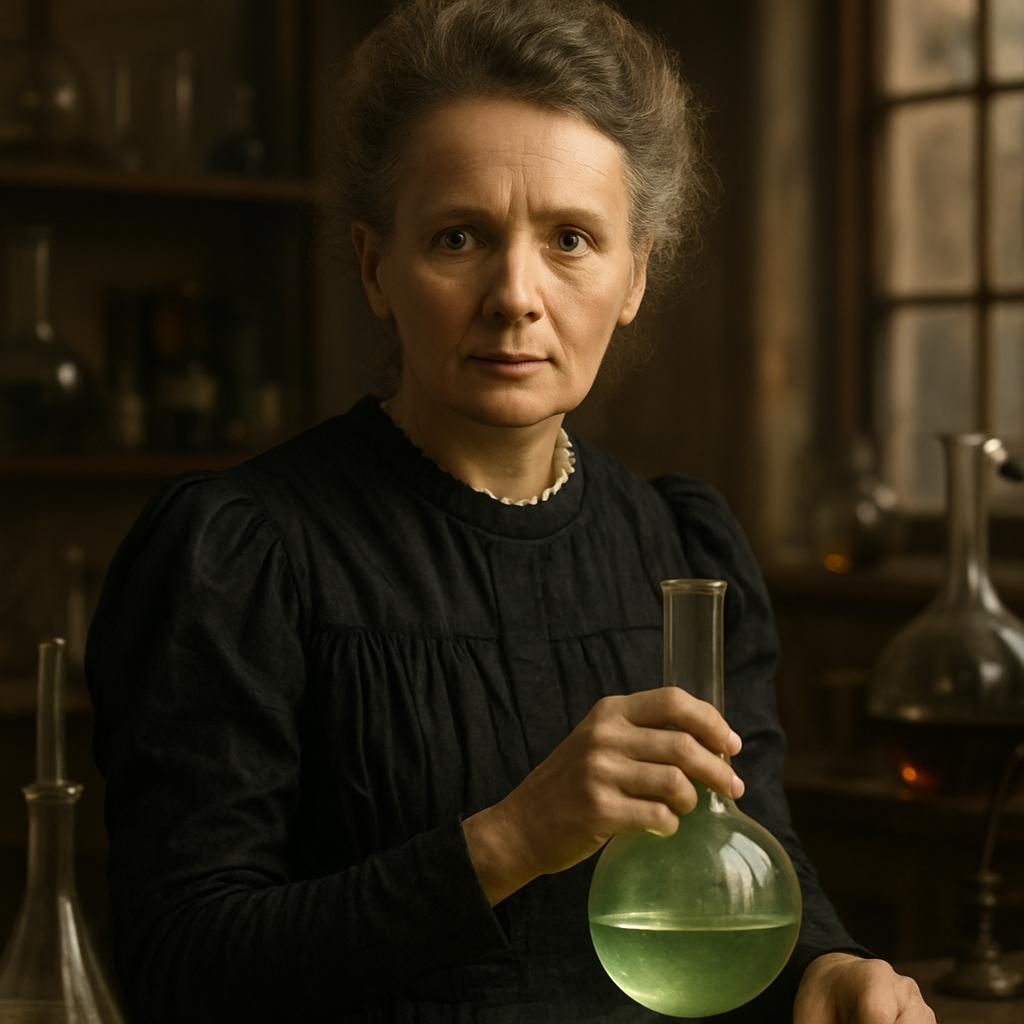
Marie Curie: The Radium Revolutionist
Here's the incredible story of a scientist who truly changed the world!
Imagine being so brilliant and determined that you not only break down scientific barriers but also social ones, becoming the first woman to win a Nobel Prize and the only person ever to win Nobel Prizes in two different scientific fields. That's the amazing story of Marie Curie!
Roots & Early Sparks
Our trailblazer, born Maria Skłodowska, entered the world on November 7, 1867, in Warsaw, Poland (NobelPrize.org, n.d.). Back then, Poland was controlled by Russia, and life was tough, especially for those who wanted a good education. Maria’s parents were both teachers, and they taught her early on the importance of learning, even when it was difficult (University of Cambridge, n.d.). She was super smart from a young age, always eager to soak up knowledge. Sadly, her mother and one of her sisters passed away when Maria was young, which was very hard on her (AIP, n.d.).
Despite her brilliance, women weren't allowed to attend university in Poland at the time. So, Maria made a brave decision. She worked as a governess to help pay for her older sister’s medical studies in Paris, dreaming of her own chance to learn there (NobelPrize.org, n.d.). Finally, at 24, she made the big move, enrolling at the famous Sorbonne University in Paris. She studied physics and math, often struggling financially, but always hungry for knowledge (AIP, n.d.). It was there she met a brilliant French physicist named Pierre Curie. They fell in love, not just with each other, but with science, and got married in 1895 (NobelPrize.org, n.d.).
Breakthrough Journey
Their scientific partnership was truly epic. Inspired by Henri Becquerel's discovery of radioactivity, Marie decided to study these mysterious rays for her doctoral thesis (University of Cambridge, n.d.). Together, Marie and Pierre began working with a mineral called pitchblende. They spent countless hours in a drafty, unheated shed, performing incredibly difficult chemical separations (AIP, n.d.).
Their painstaking work paid off! In 1898, they announced the discovery of not one, but two new elements: polonium (named after Marie's home country) and radium (named for its intense radioactivity) (NobelPrize.org, n.d.). This was a huge deal!
Hallmark Moments
- 1903 Nobel Prize in Physics: Marie, Pierre, and Henri Becquerel shared this prestigious award for their discovery of radioactivity. Marie became the first woman ever to win a Nobel Prize (NobelPrize.org, n.d.).
- 1911 Nobel Prize in Chemistry: After Pierre's tragic death in 1906, Marie continued her groundbreaking research. She received her second Nobel Prize for isolating pure radium, making her the only person to win Nobel Prizes in two different sciences (NobelPrize.org, n.d.).
- Established Radium Institute: She headed the Radium Institute in Paris, which became a leading center for studying radioactivity and its medical applications (University of Cambridge, n.d.).
- "Little Curies" in WWI: During World War I, Marie developed mobile X-ray units, known as "Petites Curies" or "Little Curies," which helped doctors locate shrapnel in wounded soldiers right on the battlefield. She even learned to drive and traveled with these units herself (AIP, n.d.).
Quirky Corner
- Marie carried test tubes of radioactive isotopes in her pockets and kept them in her desk drawer, unaware of the dangers at the time (AIP, n.d.).
- She loved riding her bicycle with Pierre in the countryside around Paris (University of Cambridge, n.d.).
- When receiving her first Nobel Prize money, she used some of it to create new laboratories and to help a school for girls in Poland (Nobel Foundation, 2011).
Ripple Effect
Marie Curie's work completely changed our understanding of matter and energy. Her discovery of radium not only paved the way for nuclear physics but also revolutionized medicine, leading to new treatments for cancer (NobelPrize.org, n.d.). She proved that science wasn't just for men, inspiring countless women to pursue scientific careers. Even today, her name is synonymous with scientific brilliance and unwavering dedication. Marie Curie died on July 4, 1934, from illnesses likely caused by her extensive exposure to radiation (AIP, n.d.). She truly gave her life to science, leaving behind a legacy that shines as brightly as the elements she discovered.
Fast Facts Box
- Born: November 7, 1867, Warsaw, Congress Kingdom of Poland (part of the Russian Empire)
- Died: July 4, 1934, Passy, France
- Spouse: Pierre Curie (m. 1895–1906)
- Children: Irène Joliot-Curie and Ève Curie
- Notable Discoveries: Polonium, Radium
- Signature Quote: "Nothing in life is to be feared, it is only to be understood. Now is the time to understand more, so that we may fear less." (University of Cambridge, n.d.)
Sources:
- American Institute of Physics (AIP). (n.d.). Marie Curie. Retrieved from https://history.aip.org/history/acap/biographies/bio.jsp?curiem
- Nobel Foundation. (2011). Marie Curie: The first woman to win a Nobel Prize. Retrieved from https://www.nobelprize.org/womenwhochangedtheworld/stories/marie-curie
- NobelPrize.org. (n.d.). Marie Curie – Biographical. Retrieved from https://www.nobelprize.org/prizes/physics/1903/marie-curie/biographical/
- University of Cambridge. (n.d.). Marie Curie: A life in science. Retrieved from https://www.cam.ac.uk/stories/marie-curie-a-life-in-science