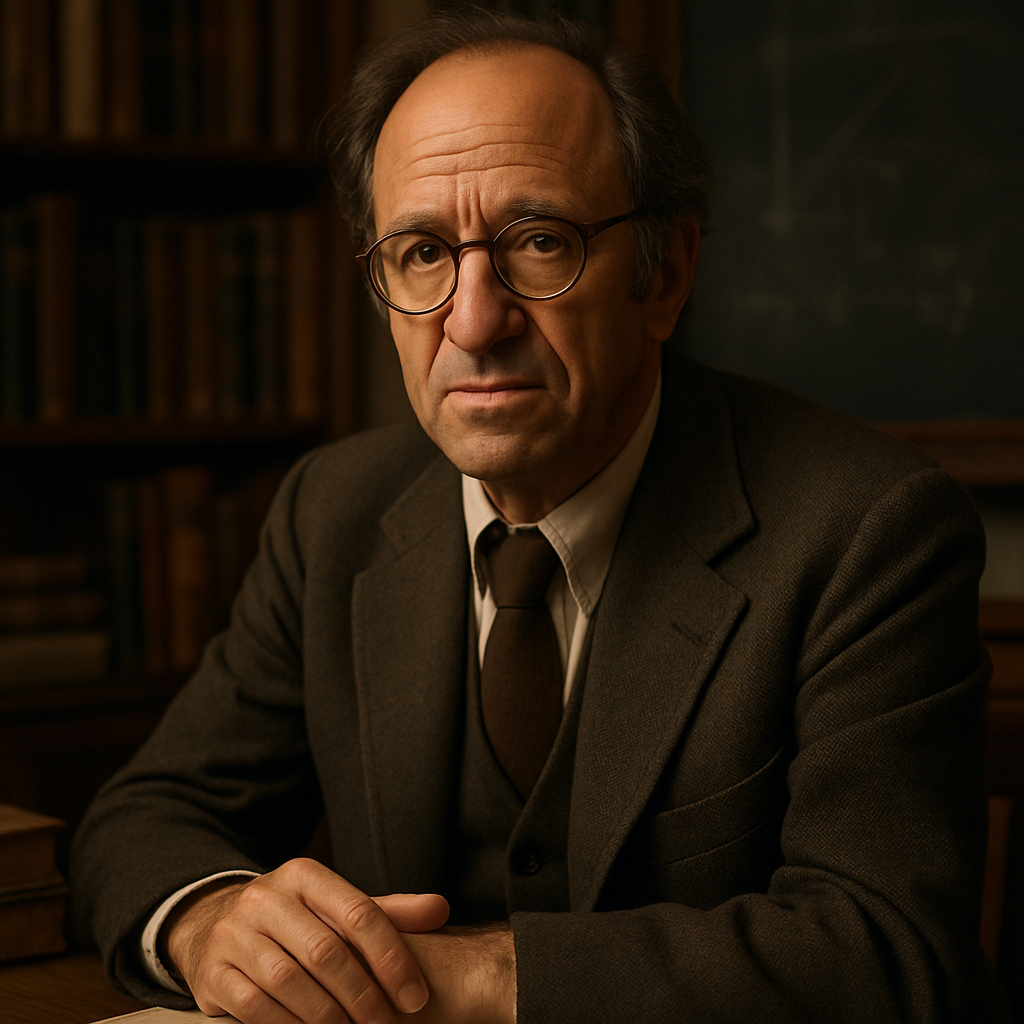
Thomas Kuhn: The Man Who Shook Up Science
Ever wonder how big ideas in science truly change? It’s not always a smooth, gradual climb! And the person who really opened our eyes to this revolutionary idea was a brilliant American thinker named Thomas Kuhn (Stanford Encyclopedia of Philosophy, 2021).
He's famous for showing us that science doesn't just add new facts, but sometimes undergoes massive "paradigm shifts" – like a whole new way of seeing the world (Britannica, 2023).
Early Life and Education
Born in Cincinnati, Ohio, in 1922, Thomas Samuel Kuhn grew up in a family that valued learning (New York Times, 1996). His dad, Samuel L. Kuhn, was an industrial consultant, and his mom, Minette Stroock Kuhn, was an editor (New York Times, 1996; Harvard Magazine, 2012). From a young age, Thomas showed a keen interest in how things worked, not just in science, but in history too.
He attended Harvard University, earning his:
- Bachelor's degree in Physics in 1943 (Britannica, 2023)
- Master's degree in Physics in 1946 (Stanford Encyclopedia of Philosophy, 2021)
- Ph.D. in Physics in 1949 (Stanford Encyclopedia of Philosophy, 2021)
The Genesis of a Revolution
Here’s where his journey got really interesting! Even though he was trained in physics, a stint teaching a history of science course at Harvard from 1948 to 1956 really sparked his groundbreaking ideas (Harvard Magazine, 2012; New York Times, 1996).
He started wondering why certain scientific ideas stuck around for a long time, only to be completely overturned later. This deep dive into the history of science led him to write his most famous book, The Structure of Scientific Revolutions, published in 1962 (Britannica, 2023). This book was a total game-changer!
Understanding "Paradigm Shifts"
The Structure of Scientific Revolutions introduced the idea of "paradigm shifts." Imagine, for example, that everyone believes the sun goes around the Earth (that's an old "paradigm"!). Then, a new idea comes along – that the Earth actually goes around the sun – and suddenly, everything changes! That’s a paradigm shift (Stanford Encyclopedia of Philosophy, 2021).
Kuhn showed that scientific progress isn't just adding new pieces to a puzzle; sometimes, you have to throw out the old puzzle and start a brand new one (Britannica, 2023).
Lasting Influence
Kuhn's work has had a huge influence, not just in science, but in fields like sociology, business, and even art! People started looking at changes in their own fields through the "paradigm shift" lens. He showed us that science is a human activity, and our understanding of things can change in truly dramatic ways.
Thomas Kuhn passed away in 1996, but his ideas continue to make us think differently about how knowledge grows and transforms (New York Times, 1996).
Fast Facts
- Born: July 18, 1922, Cincinnati, Ohio
- Died: June 17, 1996, Cambridge, Massachusetts
- Education: Harvard University (Ph.D. in Physics)
- Notable Work: The Structure of Scientific Revolutions (1962)
- Signature Quote: “A new scientific truth does not triumph by convincing its opponents and making them see the light, but rather because its opponents eventually die, and a new generation grows up that is familiar with it.” (The Structure of Scientific Revolutions, 1962)
Sources:
- Britannica. (2023, November 28). Thomas Kuhn. Retrieved from https://www.britannica.com/biography/Thomas-S-Kuhn
- Harvard Magazine. (2012, January-February). Thomas S. Kuhn, A Biographical Sketch. Retrieved from https://harvardmagazine.com/2012/01/thomas-s-kuhn-a-biographical-sketch
- New York Times. (1996, June 19). Thomas S. Kuhn, 73, Is Dead; Author of 'Structure of Scientific Revolutions'. Retrieved from https://www.nytimes.com/1996/06/19/us/thomas-s-kuhn-73-is-dead-author-of-structure-of-scientific-revolutions.html
- Stanford Encyclopedia of Philosophy. (2021, March 18). Thomas Kuhn. Retrieved from https://plato.stanford.edu/entries/thomas-kuhn/