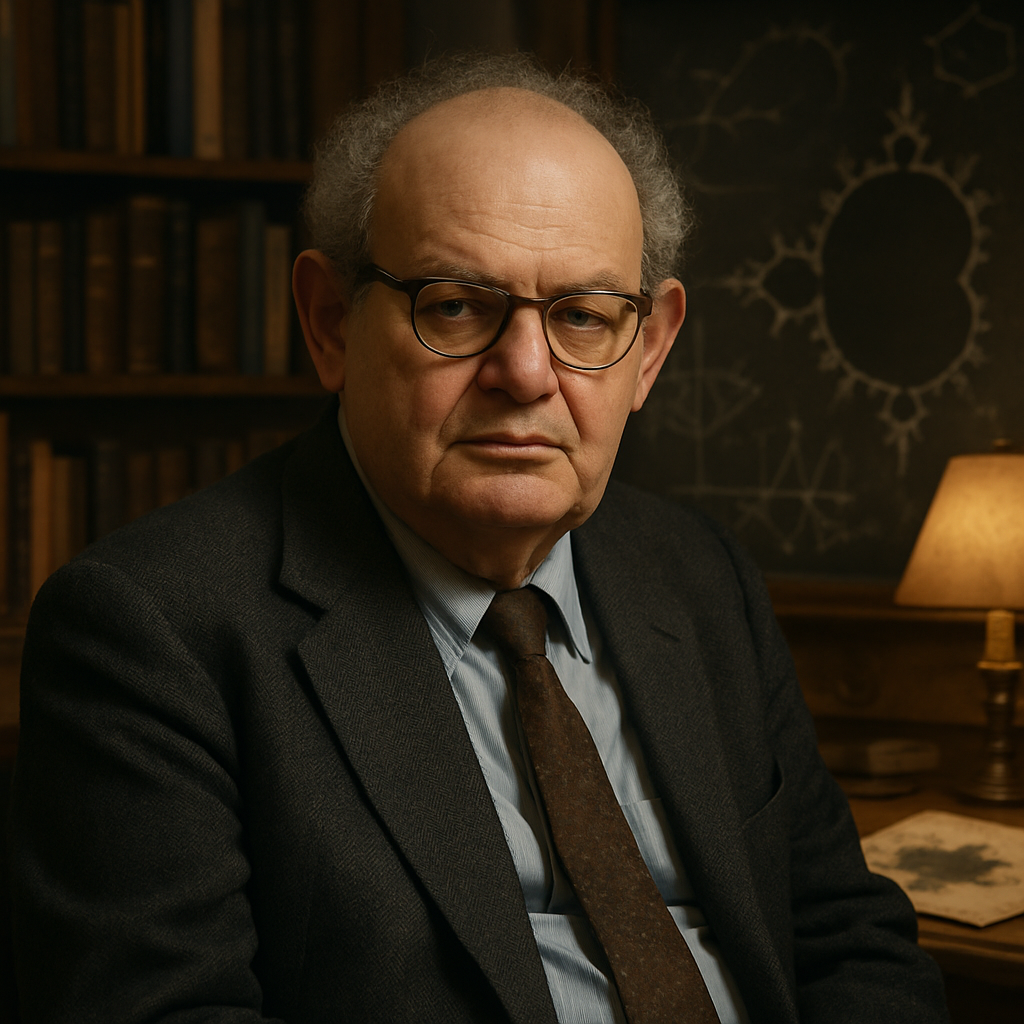
Discovering the Beauty in Chaos: The Legacy of Benoît Mandelbrot
Get ready to meet Benoît Mandelbrot, the brilliant mathematician who didn't just study shapes—he saw the hidden beauty in the jagged, the irregular, and the downright messy bits of nature! He's famous for discovering fractals, a whole new way to understand patterns that repeat themselves at different scales, revealing order in what looks like chaos (New York Times 2010).
Early Life and Influences
Born in Warsaw, Poland, in 1924, Benoît grew up in a family that loved learning. His father was a clothing merchant, and his mother was a doctor (Encyclopædia Britannica 2024). His uncle, Szolem Mandelbrojt, was a well-known mathematician in France, and he encouraged Benoît’s early interest in math (Scientific American 2010).
The family moved to France in 1936 to escape the troubles brewing in Europe (New York Times 2010). Young Benoît didn't exactly love school in the usual way; he often found traditional teaching boring but was incredibly curious about how things worked (Scientific American 2010). He especially loved looking at maps and playing with shapes, which probably hinted at his future discoveries!
A Career of Freedom and Discovery
After surviving World War II, Mandelbrot studied mathematics and engineering in France before moving to the United States. He worked at IBM's research labs for 35 years, a place where he had the freedom to explore many different ideas, not just stick to one area (IBM 2010). This freedom was super important for his groundbreaking work!
He spent years looking at everything from the way cotton prices changed to how noise affected telephone lines, and he kept seeing similar irregular patterns everywhere (New York Times 2010; Scientific American 2010).
The "Aha!" Moment: Introducing Fractals
One day, while working on a problem about "noisy" electronic signals, he realized that the patterns he was seeing weren't random at all. They were self-similar, meaning that if you zoomed in on a small part of the pattern, it looked much like the larger pattern (IBM 2010).
This "aha!" moment led him to coin the term "fractal" in 1975, using the Latin word "fractus," which means "broken" or "irregular" (New York Times 2010). The world was never quite the same after that!
Hallmark Moments
- 1975: Coined the term "fractal" and published Les Objets Fractals: Forme, Hasard et Dimension (The Fractal Objects: Form, Chance and Dimension), introducing his revolutionary ideas (Encyclopædia Britannica 2024).
- 1982: Published The Fractal Geometry of Nature, a beautifully illustrated book that shared the wonders of fractals with a wider audience and became incredibly influential (New York Times 2010).
- 1980s: Created the "Mandelbrot set," a famous fractal often called the most complex object in mathematics, known for its intricate and endlessly fascinating patterns (Scientific American 2010). It's so cool that people make art inspired by it!
Quirky Corner
- Mandelbrot often described himself as a "nomad" because he moved around a lot in his early life and never quite fit into one specific field of study (New York Times 2010).
- He believed that geometry had become too "smooth" and that mathematicians had ignored the "roughness" of the real world—like coastlines, clouds, and trees (Scientific American 2010). He dared to embrace the mess!
- He sometimes referred to geometry before fractals as "the geometry of man-made structures" and his own work as "the geometry of nature" (IBM 2010).
Benoît Mandelbrot's ideas completely changed how scientists and artists look at the world. Fractals are now used in computer graphics to create realistic landscapes, in medicine to understand how organs grow, in finance to model stock market changes, and even in engineering to design better antennas (IBM 2010; Scientific American 2010).
He showed us that even in the most complex and seemingly random things, there's often a hidden, beautiful order. He passed away in 2010, but his legacy, like a fractal, will continue to unfold in amazing ways (New York Times 2010).
Fast Facts Box
- Born: November 20, 1924, Warsaw, Poland
- Died: October 14, 2010, Cambridge, Massachusetts, USA
- Notable Works: Les Objets Fractals: Forme, Hasard et Dimension (1975), The Fractal Geometry of Nature (1982)
- Signature Quote: "Clouds are not spheres, mountains are not cones, coastlines are not circles, and bark is not smooth, nor does lightning travel in a straight line." (The Fractal Geometry of Nature)
Sources
- Encyclopædia Britannica. (2024). Benoît Mandelbrot. Retrieved from www.britannica.com
- IBM. (2010). IBM Fellow Benoit Mandelbrot passes away. Retrieved from www.ibm.com/blogs/research/2010/10/14/mandelbrot/
- New York Times. (2010, October 16). Benoît Mandelbrot, Mathematician, Dies at 85. Retrieved from www.nytimes.com/2010/10/17/science/17mandelbrot.html
- Scientific American. (2010, October 15). Benoît Mandelbrot, discoverer of fractals, dies. Retrieved from www.scientificamerican.com/article/benoit-mandelbrot-dies/