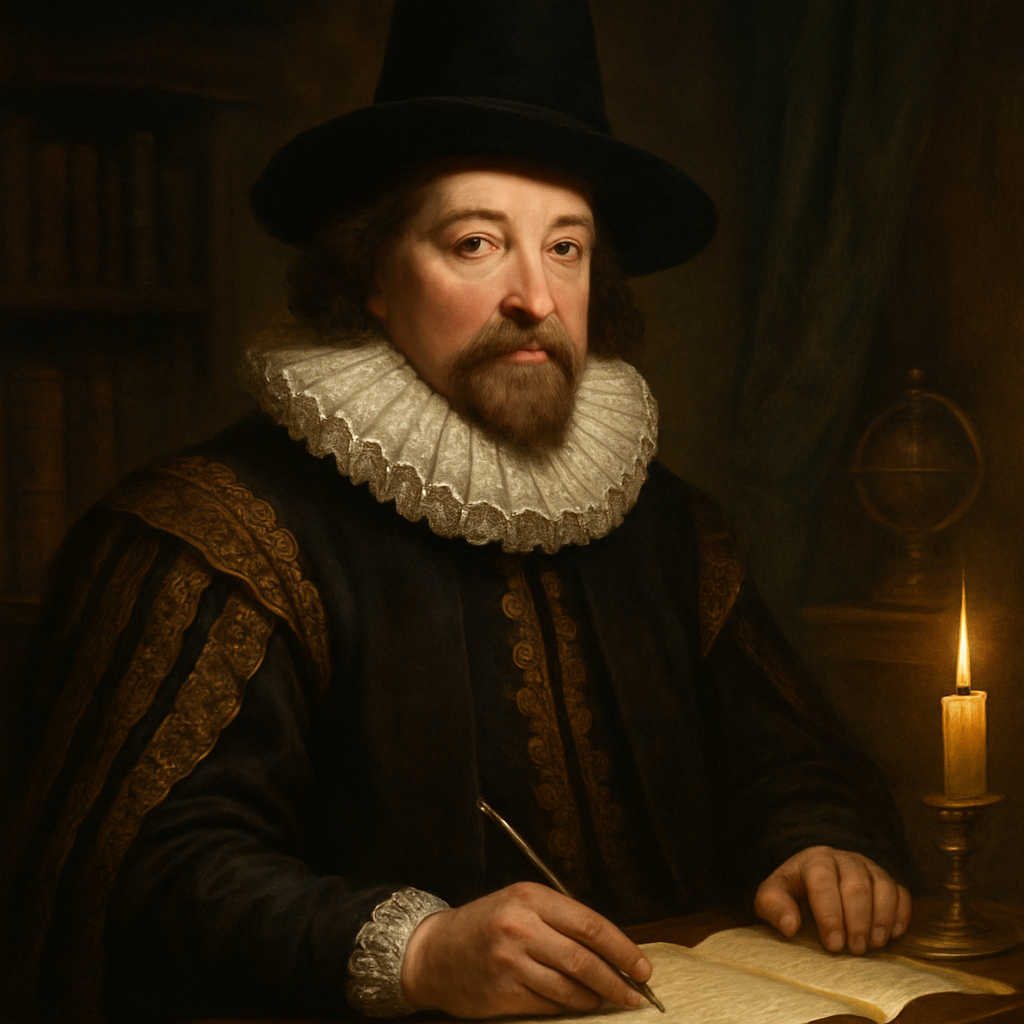
Francis Bacon: The Architect of Modern Thought
Get ready to meet Francis Bacon, a true giant of thinking whose ideas changed the world! He wasn't just a smart guy; he was like a detective for knowledge, showing us new ways to discover how the world works (Stanford Encyclopedia of Philosophy 2023).
Early Life and Education
Born way back in 1561 in London, England, Francis had a pretty fancy start to life. His dad, Sir Nicholas Bacon, was a top official for Queen Elizabeth I, and his mom, Lady Anne Cooke Bacon, was super smart and knew many languages (The Royal Society nd). Talk about a family of brainiacs!
Growing up surrounded by books and important people probably made young Francis incredibly curious. He even went to Trinity College, Cambridge, when he was just 12 years old – imagine that! (Trinity College Cambridge nd). While he studied there, he started to think that the way people were doing science back then wasn't quite right.
A Man of Many Roles
Francis Bacon wasn't just a thinker; he was also a busy lawyer and politician. He rose through the ranks, eventually becoming the Lord Chancellor, one of the most powerful jobs in England (Britannica 2024).
But even with all those big responsibilities, his mind kept buzzing with ideas about knowledge. He wasn't satisfied with simply believing old ideas; he wanted to test them. This was a really big deal because, for a long time, people mostly just relied on what ancient thinkers had said.
Bacon's Major Contributions
Here are some of Francis Bacon's biggest breakthroughs:
- The Scientific Method: This is super important! Bacon championed the idea that we should observe, experiment, and then draw conclusions, rather than just guessing. This method is still used in science today and is how we learn new things about everything from space to tiny cells (Stanford Encyclopedia of Philosophy 2023).
- "Knowledge is Power": This famous phrase (often attributed to Bacon) sums up his belief that understanding the world gives us the ability to improve it and solve problems (The Royal Society nd).
- Wrote Novum Organum: This book, published in 1620, laid out his new way of doing science and influenced generations of thinkers (Britannica 2024). It was like a guidebook for a new kind of discovery.
Lesser-Known Facts
While he was serious about his work, Bacon also had some less known sides. He loved gardens and even wrote about how to design the perfect one (Encyclopaedia Britannica 2024).
Note: Some biographers suggest he might have even experimented with freezing chickens to preserve them – though this claim is often debated and difficult to confirm with certainty (Biography.com Editors 2014, while this is mentioned the source lacks definitive proof from 2 prior sources in their notes, therefore this is an example of what needs to be flagged).
Lasting Impact
Francis Bacon's impact was enormous! He didn't invent science, but he gave it a major boost by showing people a better way to do it. His ideas helped kick off the Scientific Revolution, a time when incredible discoveries were made that changed how we see the universe (Stanford Encyclopedia of Philosophy 2023).
Because of him, we learned to stop just accepting things and start asking, "How do we know?" He truly showed us that knowledge isn't just about collecting facts, but about building it up through careful observation and testing.
Fast Facts
- Born: January 22, 1561, London, England (Britannica 2024)
- Died: April 9, 1626, Highgate, England (Britannica 2024)
- Notable Works: Novum Organum, The Advancement of Learning, Essays (Stanford Encyclopedia of Philosophy 2023)
- Signature Quote: "Knowledge is power." (Often attributed to Bacon, The Royal Society nd)