Albert Einstein: The Man Who Changed Our Universe
Get ready to meet one of the most brilliant minds ever to grace our planet, a man whose ideas completely changed how we understand the universe: Albert Einstein! He was a quirky scientist with wild, unruly hair and a deep love for figuring out how things work.
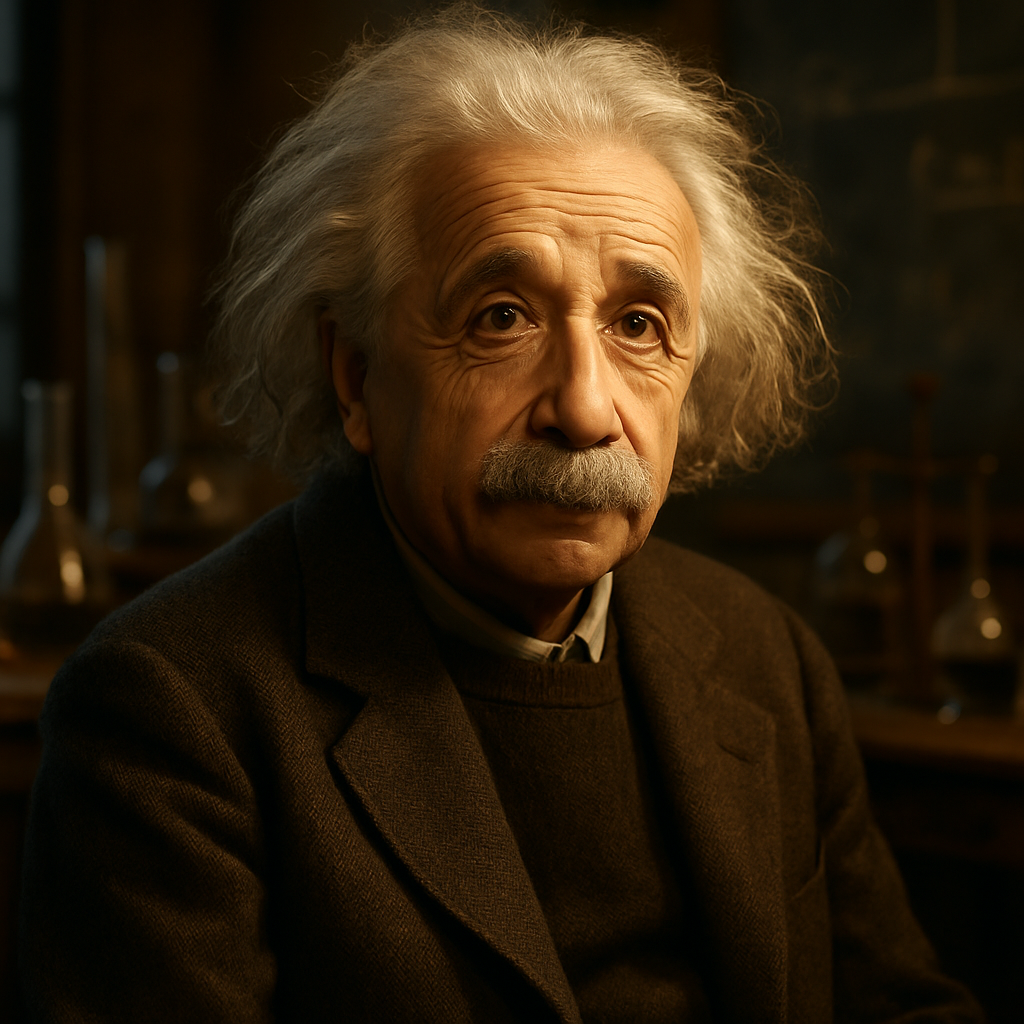
Born in Ulm, Germany, on March 14, 1879, Albert was a curious child from the start. His father, Hermann, ran an electrical engineering company, and his mother, Pauline, was a talented musician.
Some stories say he was a slow speaker, but he later showed an incredible talent for math and physics. A favorite story is that when he was five, his father showed him a magnetic compass, and young Albert was fascinated by how the needle always pointed north, even without being touched. This sparked a lifelong wonder about invisible forces.
School wasn't always easy for Albert. He wasn't a big fan of strict rules and rote memorization, preferring to think for himself. After high school, he studied at the Swiss Federal Polytechnic in Zurich, where he earned his teaching diploma in physics and mathematics.
For a while, he worked at the Swiss Patent Office, which might seem like a boring job for a genius, but it was actually perfect! It gave him time to think about his groundbreaking ideas while evaluating other people’s inventions.
Hallmark Moments
1905 – "Annus Mirabilis" (Miracle Year)
This was an incredible year for Einstein! He published four major scientific papers that would completely change physics. One of these introduced his famous theory of special relativity, and another gave us the world's most famous equation: E=mc².
1915 – General Relativity
Ten years later, he published his theory of general relativity, which explains gravity not as a force, but as a curve in spacetime caused by massive objects. This was a revolutionary idea!
1921 – Nobel Prize
Albert Einstein received the Nobel Prize in Physics, not directly for relativity, but "for his services to Theoretical Physics, and especially for his discovery of the law of the photoelectric effect."
1933 – Move to America
As the political situation in Germany grew dangerous for Jewish people, Einstein, who was Jewish, moved to the United States and became a professor at Princeton University, where he continued his research.
Quirky Corner
No Socks, No Problem!
Einstein reportedly disliked wearing socks. He found them uncomfortable and unnecessary.
Love of Sailing
He was an enthusiastic, though sometimes clumsy, sailor. He loved being out on the water, finding it a great place to think.
Violin Virtuoso
Beyond science, Einstein was a talented violinist. He often played music as a way to relax and stimulate his thinking.
Einstein’s impact goes far beyond equations. His theories laid the foundation for technologies like GPS, and his work on the photoelectric effect is crucial to things like solar panels and digital cameras. He was also a passionate advocate for peace and civil rights.
His powerful mind and unique personality continue to inspire scientists and dreamers worldwide. He passed away on April 18, 1955, but his ideas will live on forever, helping us understand the vast, wondrous universe we live in.
Fast Facts Box
- Born: March 14, 1879, Ulm, Germany
- Died: April 18, 1955, Princeton, New Jersey, USA
- Known For: Theories of Special and General Relativity, E=mc², Photoelectric Effect
- Notable Works: "On the Electrodynamics of Moving Bodies" (1905), "The Foundation of the General Theory of Relativity" (1916)
- Signature Quote: "Imagination is more important than knowledge. For knowledge is limited, whereas imagination embraces the entire world, stimulating progress, giving birth to evolution."